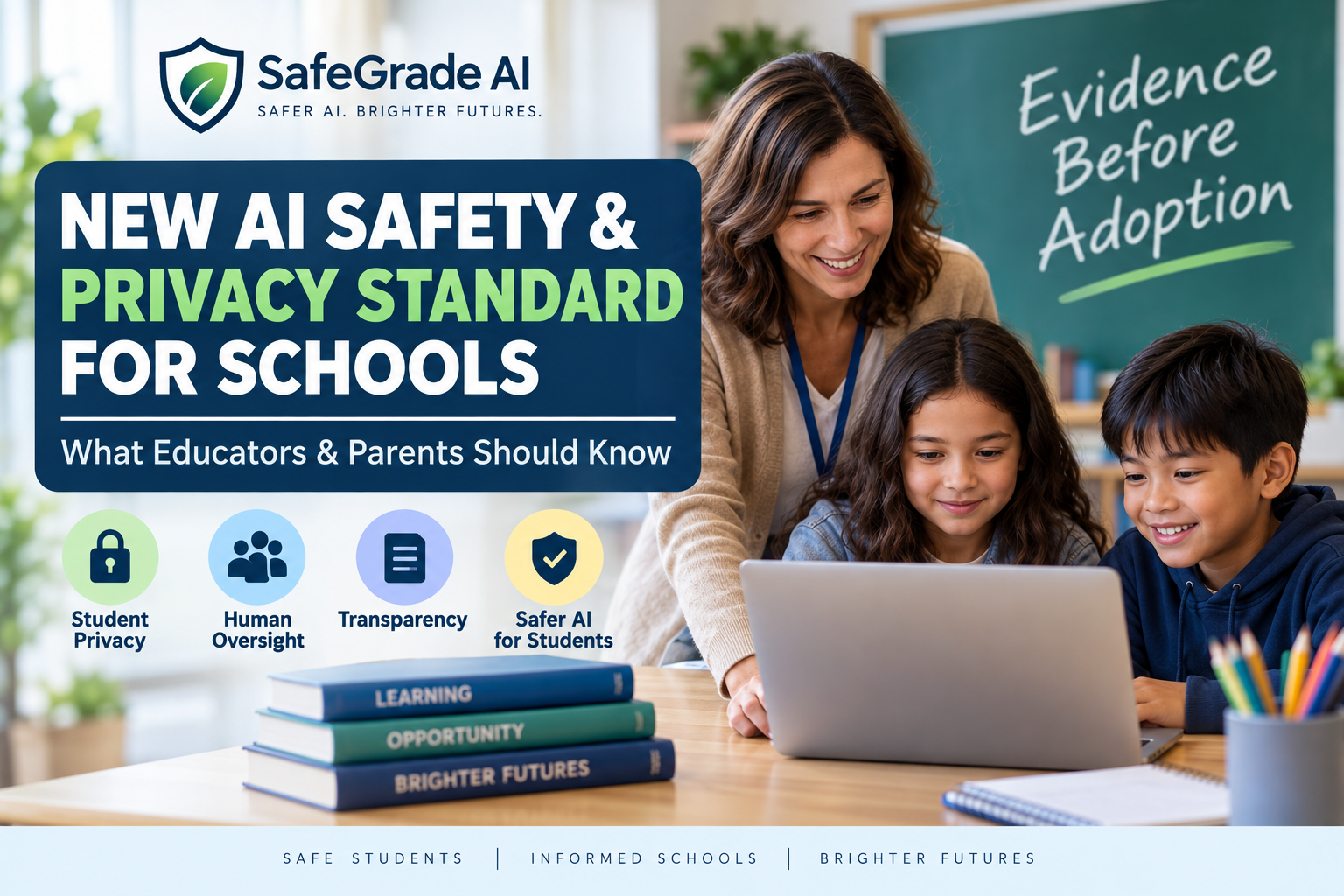
Microsoft and Teachers Unions Set a New AI Safety & Privacy Standard for Schools — What Schools Should Know
A new agreement establishes stronger protections for student data, transparency, human oversight, and AI safety — but schools still need evidence before adopting individual AI tools.
- Independent
Evaluations - Age-Appropriate
Recommendations - Privacy & Safety
Transparency
At a Glance
What Changed?
On September 9, 2026, Microsoft, the American Federation of Teachers (AFT), and the United Federation of Teachers (UFT) announced what they describe as the first legally enforceable AI safety and privacy agreement of its kind involving a major technology company and teachers unions.
The agreement establishes protections for Microsoft education products used by schools.
Beginning November 1, Microsoft says the standard will extend to U.S. school districts with Microsoft contracts, with districts able to incorporate the protections into their customer agreements.
That last point matters.
These aren't simply recommended best practices.
The agreement is designed to make specific protections contractually enforceable, giving school systems stronger mechanisms for holding Microsoft accountable.
For parents, this represents something many families have been asking for: clearer information about what happens when children interact with AI at school.
For educators and administrators, it provides a more concrete benchmark for evaluating vendor promises about privacy and safety.
What Does the New Standard Protect?
The agreement is extensive, but several provisions are particularly important for K–12 schools and families.
1. Student and Educator Data Cannot Be Used for General AI Training
Microsoft has agreed not to use covered student and educator data to train its general AI models, with limited exceptions related to protecting students.
The agreement also restricts using that information for advertising, selling it, or repurposing it for unrelated product development.
That addresses one of the most important questions schools should ask any AI company:
What happens to student information after a child enters it into the system?
2. Schools Maintain Greater Control Over Their Data
Schools are supposed to retain control over how covered data is used, stored, retained, and deleted.
This is important because approving an AI product should never mean giving a technology company unlimited control over student information.
Schools need to understand not only what information a tool collects, but also:
- Why it collects it
- How long it keeps it
- Who can access it
- Whether it is shared
- How it can be deleted
- Whether the company uses it for purposes unrelated to education
Those questions should become routine parts of AI procurement and approval.
3. Important Decisions Require Human Oversight
The agreement requires human oversight for consequential decisions involving students and educators.
That principle is particularly important in education.
AI can assist people with information and recommendations. It should not quietly replace professional judgment in decisions that significantly affect a child.
Teachers, administrators, counselors, specialists, and families need to remain part of those decisions.
4. Families Should Receive Understandable Information
Parents should not need to be privacy attorneys or AI engineers to understand the technology their children are required to use.
Under the agreement, families are supposed to receive clearer, accessible information about how covered AI tools work, what information they collect, and what safeguards are in place.
That is a significant principle for the entire education-technology industry:
Transparency should be understandable to the people whose children are actually using the product.
Is Your Child Already Using AI?
They probably are — even if they aren't using ChatGPT.
SafeGrade AI's Free Family AI Safety Course + Starter Pack gives parents practical guidance for setting AI boundaries, talking with children about AI, and making safer decisions about the tools their kids use.
5. AI Should Not Be Designed to Create Emotional Dependency
The agreement prohibits AI companion features designed to foster emotional attachment or dependency and limits designs intended to keep students engaged longer than necessary for a learning task.
This is an especially important issue for children and teenagers.
AI systems can communicate in remarkably human-like ways. Younger users may not always understand the boundaries between a responsive computer system and a genuine human relationship.
Schools evaluating student-facing AI should therefore consider more than academic functionality.
They should also examine how the AI interacts with children.
6. Companies Need to Communicate Meaningful Product Changes
AI products can change quickly.
A tool a district evaluated six months ago may not operate exactly the same way today.
New models, features, integrations, data practices, age restrictions, and safeguards can materially change a product's risk profile.
The Microsoft agreement includes requirements around communicating product changes, risks, and controls.
This points toward another important shift in school AI governance:
AI evaluation cannot be a one-time event.
Approval should be followed by monitoring and reevaluation.
Why This Standard Matters Beyond Microsoft
The agreement currently applies to Microsoft — not automatically to every AI company serving schools.
That distinction is important.
However, it could influence what school districts begin expecting from other vendors.
Microsoft has publicly encouraged other technology companies to meet the same standard. OpenAI and Anthropic have said they are discussing their own agreements with the AFT.
That means school leaders now have a useful question to ask AI vendors:
If these protections can be provided by one major AI company, why shouldn't we expect comparable protections from others?
Smaller districts may benefit particularly from stronger industry standards.
Large school systems often have legal teams and purchasing power that allow them to negotiate extensive vendor protections. Smaller schools and districts may not.
Clearer baseline standards could help reduce that disparity.
But Safety and Privacy Are Only the Beginning
This is where the conversation becomes especially important.
An AI tool can have strong privacy protections and still be the wrong tool for a particular classroom.
It can protect student data and still provide inaccurate information.
It can comply with a district's privacy requirements and still be developmentally inappropriate for an eight-year-old.
It can include strong security controls and still encourage students to outsource thinking they should be learning to do themselves.
It can satisfy a vendor checklist without demonstrating that it improves learning.
That is why schools need to separate two questions.
Question 1: Can we trust this tool?
Schools should evaluate privacy, security, data practices, transparency, student safeguards, human oversight, and vendor accountability.
Question 2: Should our students use this tool?
Schools should also evaluate age appropriateness, educational purpose, accuracy and reliability, developmental impact, student well-being, potential for cognitive overreliance, evidence of educational benefit, risks compared with benefits, and whether a lower-tech or non-AI alternative would accomplish the same goal.
Both questions matter. Passing the first test should not automatically mean passing the second.
Evidence Before Adoption
The rapid expansion of AI creates understandable pressure on schools.
Administrators do not want their students to fall behind. Teachers want tools that genuinely make their work easier and improve learning. Parents want children prepared for an AI-driven future.
At the same time, families and educators want assurance that schools are not experimenting on children simply because a new technology has become popular.
These goals do not have to conflict.
Schools do not need to become either pro-AI or anti-AI.
They need a reliable process for making decisions.
That process should start with a straightforward principle:
Evidence Before Adoption.
Before approving an AI tool, schools should be able to answer:
- What problem are we trying to solve?
- Why is this particular tool appropriate for these students?
- What evidence supports its use?
- What risks have we identified?
- What safeguards are in place?
- What student information does it collect?
- How will we know whether it is actually helping?
- What would cause us to reevaluate or discontinue it?
Those questions create a much stronger foundation for AI decision-making than either enthusiasm or fear.
The Growing Importance of Independent Evidence
The AFT's broader education-technology plan goes beyond privacy protections.
It has also called for an independent research consortium to study the effects of AI, screens, and technology on students — and specifically argues that this research should not be funded by the industries whose products are being evaluated.
That principle deserves attention.
Technology companies can provide schools with valuable information about their products.
But vendor claims are not the same thing as independent evidence.
Schools should be able to consider both.
Independent evaluation can help administrators separate what a company promises from what the available evidence actually demonstrates.
That becomes increasingly important as hundreds of AI-enabled products compete for a place in classrooms.
What School Leaders Can Do Now
Schools do not need to wait for every state or federal agency to establish comprehensive AI regulations.
They can begin strengthening their evaluation process now.
Start by identifying every student-facing AI tool currently approved or being considered.
Then document why each tool is being used, which students can access it, what information it collects, what safeguards exist, and what evidence supports its educational use.
Schools should also establish a schedule for reevaluation.
That last step is easy to overlook.
Traditional instructional materials may remain relatively unchanged for years. AI products can change in weeks.
A responsible approval process therefore needs to include:
Evaluate → Approve → Document → Monitor → Reevaluate
That is the difference between simply adopting AI and actually governing it.
Evaluating AI for Your School?
School Pro gives schools independent AI evaluations and ongoing governance intelligence to support better AI decisions.
Help your school evaluate emerging tools, understand important risks and safeguards, develop clearer guidance, and keep up as AI products and policies evolve.
Independent evaluation. Ongoing governance. Better AI decisions.
What Parents Can Ask Their Schools
Parents do not need to understand every technical detail of artificial intelligence to ask good questions.
Start with these:
- Which AI tools is my child allowed or required to use?
- Why did the school choose them?
- What student information do they collect?
- Can that information be used to train AI models?
- What safeguards are appropriate for my child's age?
- What evidence shows the tool benefits learning?
- How does the school monitor the tool after approval?
A school should be able to provide understandable answers.
And if administrators do not yet have all of them, those questions can help identify where stronger governance is needed.
What This Means for AI Companies
The Microsoft agreement also sends a message to companies selling AI products to schools.
Privacy, safety, transparency, and human oversight are increasingly becoming baseline expectations.
Vendors should be prepared to explain clearly:
- What their AI does
- What information it collects
- How student information is used
- Whether information is used for AI training
- What age groups the product was designed for
- What safeguards exist for children and teenagers
- What happens when the AI gets something wrong
- What independent evidence supports claims about educational effectiveness
- How schools will be informed when the product changes
The days of asking schools to simply trust that an AI product is “safe for education” should be ending.
Schools need evidence. Families deserve transparency. And responsible AI companies should be prepared to provide both.
From AI Adoption to AI Governance
The Microsoft-AFT-UFT agreement is significant because it raises expectations for what responsible AI safety and privacy can look like in schools.
But it also reveals the next challenge.
Schools don't simply need AI policies.
They need a repeatable system for deciding which individual AI tools meet those policies — and whether those tools should be used by students in the first place.
That requires more than a privacy checklist.
It requires evaluating safety, age appropriateness, educational purpose, evidence, transparency, and ongoing product changes together.
The goal isn't to keep AI out of education.
And it isn't to put AI into every classroom.
The goal is much simpler:
Give educators and families confidence that the technology placed in children's hands has earned its place there.
That is what Evidence Before Adoption means.
And as AI becomes a routine part of education, it may become one of the most important principles schools can follow.
Before Approving an AI Tool, Ask:
SafeGrade AI Recommendation:
Treat strong privacy and safety standards as the beginning of AI evaluation, not the end. Schools should establish a repeatable process for evaluating individual AI tools before adoption and monitoring them afterward. Consider privacy, safety, age appropriateness, educational purpose, evidence of benefit, transparency, and ongoing product changes together. Evidence Before Adoption: AI tools should earn their place in the classroom through evidence, not hype, fear, or vendor promises.
FAQs
Evaluating Every AI Tool Shouldn't Fall on Your Staff.
School Pro gives schools independent AI evaluations and ongoing governance intelligence to support better AI decisions.
Help your school evaluate emerging tools, understand important risks and safeguards, develop clearer guidance, and keep up as AI products and policies evolve.
Independent evaluation. Ongoing governance. Better AI decisions.