3 Questions Parents Should Ask Their Children About AI
One question for each age group — ages 5–10, 11–14, and 15–18 — to start honest, judgment-free conversations about how your child actually uses AI.
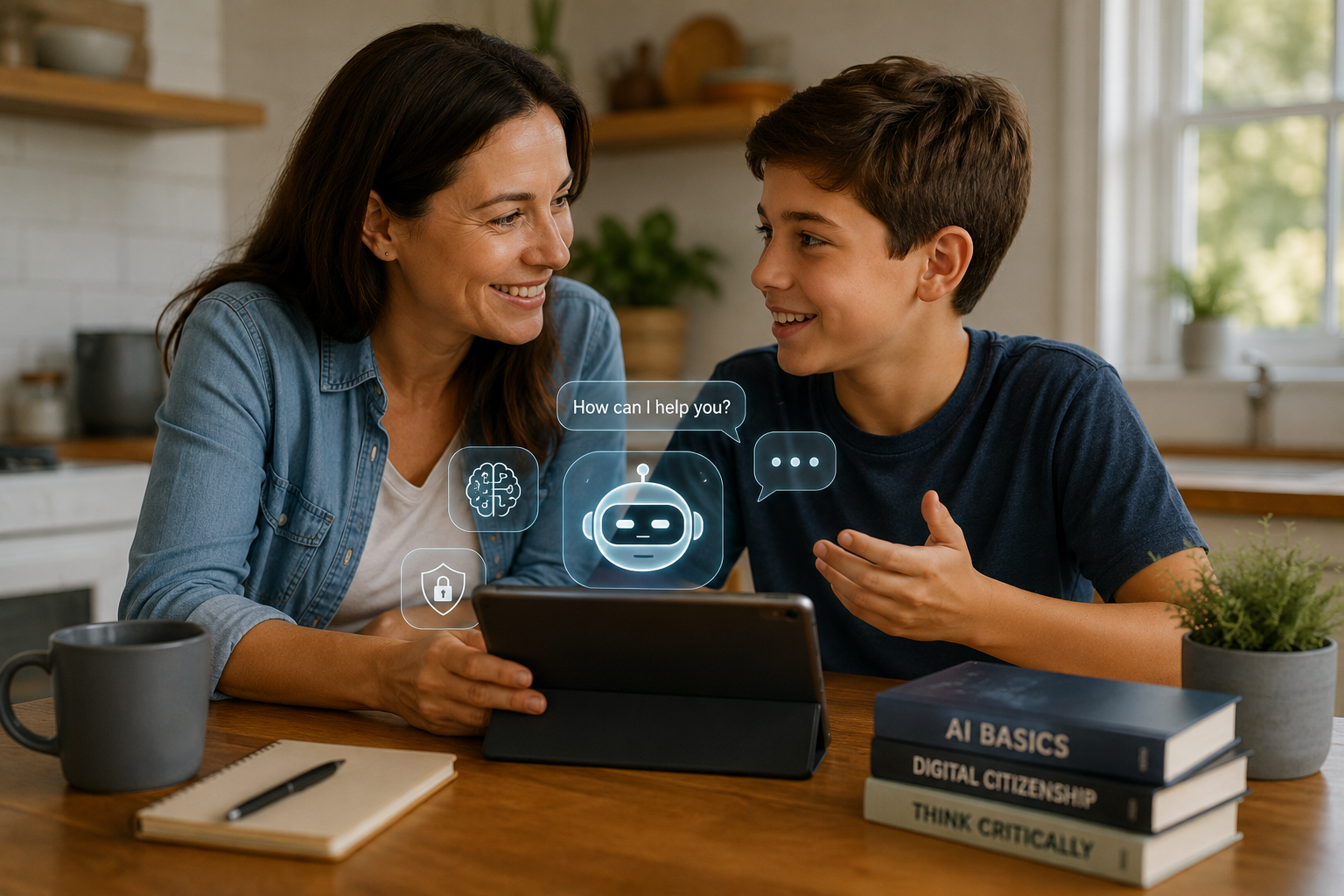
Artificial intelligence is quickly becoming part of children's everyday lives, whether they're using it for homework, creative projects, or simply exploring online. One of the best ways to help children use AI safely isn't another app or setting—it's a simple conversation. In the Family AI Safety Starter Pack, I share 30 age-appropriate conversation starters designed to help parents begin meaningful discussions about AI. Today, I'd like to share one question from each age group to help you get started.
Ages 5–10
"If the computer told you something silly, how would you know?"
Young children naturally trust technology. If a computer says something confidently, many assume it must be true.
This question helps children begin thinking critically instead of automatically believing everything they hear from AI. You might be surprised by their answers. Some children will say they would ask a parent, while others may admit they wouldn't know the difference.
Use this conversation to explain that computers can sometimes make mistakes or invent information, and that's why it's always okay to ask questions and double-check surprising answers.
Ages 11–14
"What's the weirdest answer an AI gave you this month?"
Preteens and middle school students often experiment with AI tools in creative ways. They've probably already seen AI generate strange, inaccurate, or even funny responses.
Instead of asking whether they're using AI—which can sometimes feel like an interrogation—invite them to share an experience. Kids generally enjoy talking about unusual or humorous AI responses.
Their answer also gives you insight into which AI tools they're using and how they're interacting with them. More importantly, it creates an opportunity to discuss why AI sometimes produces incorrect information and why human judgment still matters.
Ages 15–18
"Where's the line between 'AI helped' and 'AI did it'?"
High school students face increasing pressure to perform academically, and AI can be an incredibly helpful tool for brainstorming, studying, organizing ideas, and improving writing.
At the same time, it's important for teens to think about where assistance becomes replacing their own work.
Rather than focusing on rules or punishment, encourage an honest discussion about integrity, learning, and personal growth. Ask them where they believe the line should be and listen carefully to their perspective.
These conversations help teens develop their own ethical decision-making skills long before they're faced with difficult situations in college or the workplace.
The SafeGrade AI Take
The goal isn't to quiz your children every time they use AI.
Children are much more likely to talk openly when conversations feel natural, curious, and judgment-free. Asking thoughtful questions builds trust, helps you understand how they're using AI, and creates opportunities to guide them before small misunderstandings become larger problems.
AI is changing rapidly, which means one conversation isn't enough. A few minutes of open dialogue every week can do far more than a long lecture once a year. When children know they can talk honestly about their experiences, parents gain something far more valuable than perfect answers—they gain visibility into how AI is becoming part of their child's world.
Download the Family AI Safety Starter Pack
These three questions are just the beginning.
The FREE Family AI Safety Starter Pack includes 30 conversation starters organized by age group, along with practical checklists, red flags to watch for, a Family AI Agreement, and simple tools to help families build safe AI habits together.
This week, choose just one of these questions and ask your child. You don't need to have all the answers. Simply starting the conversation is one of the most important steps you can take toward helping your family navigate AI safely and confidently.
Continue reading
More articles from the SafeGradeAI editorial team.
The Hidden Risks of Unverified AI Tools in Schools
Schools are adopting generative AI faster than they can vet it. Here are the five risk vectors administrators consistently underestimate, and how the SafeGradeAI rubric surfaces them.
How Parents Can Evaluate AI Apps Safely
A practical at-home checklist parents can run in 10 minutes before letting their child use a new AI assistant, tutor, or companion app.
AI Policy Frameworks Every School District Should Have
The four governance documents your district needs before the next school year, with a starter template structure for each.
What COPPA and FERPA Mean for AI Platforms
A plain-English walkthrough of the two US laws that govern student data, what they require of AI Vendors, and the questions districts should ask before buying.